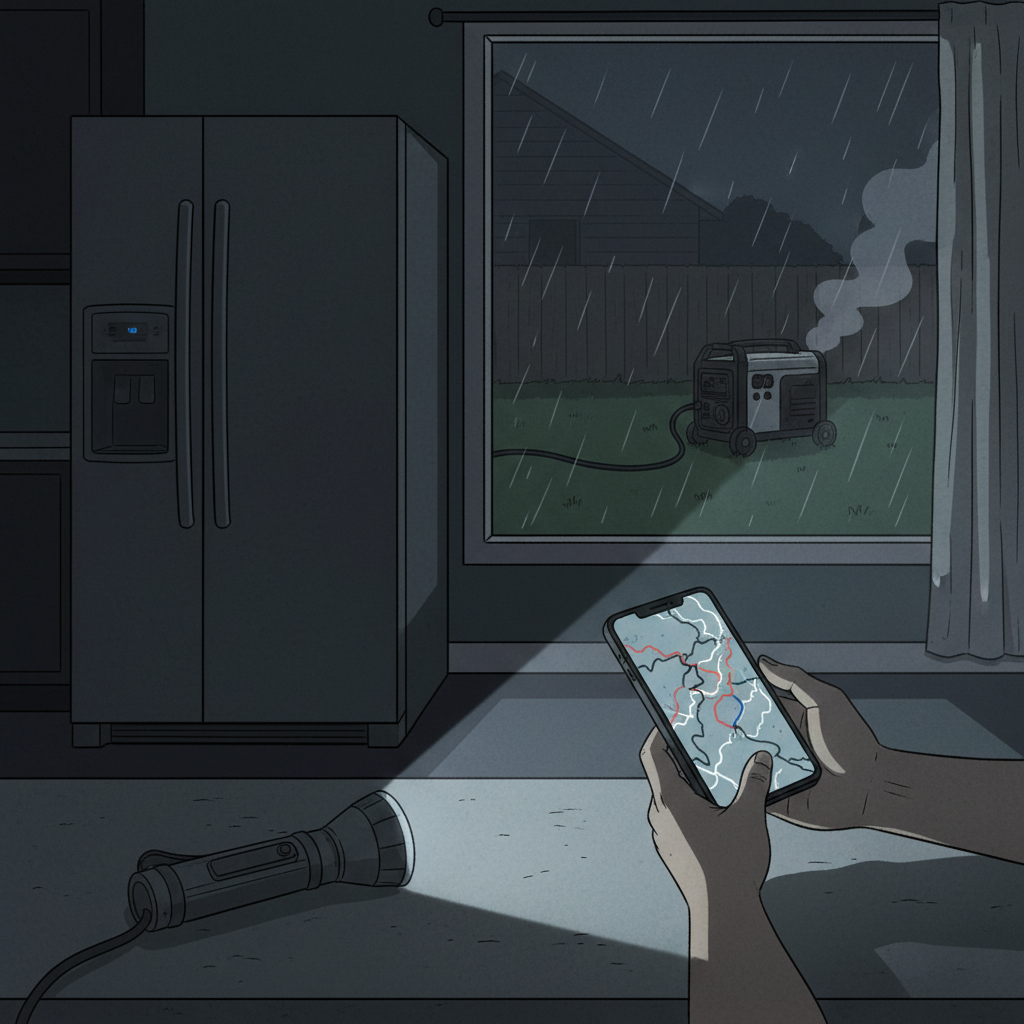
About 33.9 million US households, or 1 in 4, reported being completely without power at least once in a year, and about 70% of those households said at least one outage lasted 6 hours or more. If you are searching for a power outage near me, you usually need two answers at once: whether the outage is widespread and what you should do right now to stay safe. The steps change with time, food temperature, medical needs, and hazards outside, so the key question is how to turn an outage report into the right next action.
Outage size changes your next step
A local outage map helps you tell the difference between a house problem and a broader grid problem. PowerOutage.us provides real-time outage maps with data updated every few minutes from utilities across the United States.
That matters because the scale of the outage changes what action makes sense. If many nearby customers are out, the first job is usually reporting the outage and shifting to safety steps at home. If your home is the only one affected, you may still need to report it, but the situation is less about regional disruption and more about your specific service connection.
Outages are also not distributed evenly. In 2023, 22.8% of urban households reported outages, compared with 35.4% of rural households. Homeowners also reported outages more often than renters, 28.3% versus 19.9%. Those numbers do not predict your exact outage, but they explain why some areas and housing situations see this problem more often.
How reporting fits into restoration
Most US utilities offer online forms, phone hotlines, and text messaging options for outage reports. Reporting matters because utilities need location-level reports to match what their systems show on the map with what customers are seeing on the ground.
If you see downed lines, distance matters more than outage reporting speed. Stay at least 35 feet away from downed power lines and call 911. A damaged line is both a utility issue and an emergency scene.
Time changes food and medicine
The most important clock in a power outage is often not the restoration estimate. It is the time your refrigerator, freezer, and temperature-sensitive medication spend warming up.
Perishable food in a refrigerator should be discarded if the power is out for more than 4 hours. The reason is temperature control: refrigeration slows bacterial growth only while food stays cold enough. Once a refrigerator stays off long enough, the safe-storage barrier breaks down.
Freezers work on a different timetable because frozen food starts colder and has more thermal reserve. A full freezer will keep food safe for about 48 hours, or 24 hours if it is half full, as long as the door remains closed. The amount of food matters because a fuller freezer holds cold temperature longer.
Medication can create an earlier deadline than food. Some medications require refrigeration and may lose effectiveness if kept above 40b0F for more than a few hours during a power outage. That means an outage that seems manageable for dinner may still require urgent action for health needs.
Indoor hazards rise after dark
When the lights go out, people often replace electricity with flame or fuel. That swap creates the biggest safety risks of many outages.
Flashlights are safer than candles during a power outage because they reduce fire risk. A candle solves the lighting problem by adding an open flame inside the home. A flashlight solves the same problem without introducing that ignition source.
Generators create a different danger. Never use a generator inside a home or garage, even if doors and windows are open, because of the risk of carbon monoxide poisoning. Carbon monoxide is dangerous because it can build up in enclosed or partly enclosed spaces where exhaust cannot disperse safely.
Every home should have at least one carbon monoxide alarm that meets UL 2034 standards. If a generator or other fuel-burning source is part of your outage plan, that alarm is a basic protection layer, not an extra feature.
Ready.gov also advises disconnecting appliances and electronics during a power outage to avoid damage from electrical surges. The hazard comes when power returns. Restoration can send a surge through connected devices at the moment electricity is re-energized.
Long outages change the plan
Simple outage advice starts to fail when the outage lasts longer than a few hours. Food safety, medication storage, and whether you can stay home all become separate decisions.
About 2.9 million US households, or 8.4%, reported having to stay away from home overnight because of a power outage. That number matters because staying home is not always the safest or most practical option once refrigeration limits, medical needs, or wider community damage start to stack up.
Preparedness also needs to match duration, not just the first evening. The American Red Cross advises storing at least 2 weeks of non-perishable food and water for emergencies, including power outages. That is a very different plan from relying on refrigerator food that becomes unsafe after 4 hours.
There is also a common belief that opening windows makes indoor generator use acceptable. It does not. The rule does not change when doors or windows are open, because the carbon monoxide risk remains.
Act by outage length
Power outage action tree
- 0 to 4 hours: Check a live outage map, report the outage through your utility’s web, phone, or text options, use flashlights instead of candles, and keep refrigerator and freezer doors closed.
- More than 4 hours: Discard perishable food from the refrigerator. Keep the freezer closed and track whether it is full enough to stay safe for about 48 hours or only half full for about 24 hours.
- Any time medication needs refrigeration: Treat medicine storage as a priority if it may be above 40b0F for more than a few hours.
- Any time you see downed lines: Stay at least 35 feet away and call 911.
- Any time you use backup power: Never run a generator inside a home or garage, and make sure your home has at least one UL 2034 carbon monoxide alarm.
Where to check and report
| Tool | What it helps you do |
|---|---|
| PowerOutage.us map | See real-time outage maps updated every few minutes across the US. |
| Utility website | Submit an outage report online and check local restoration updates. |
| Utility phone line | Report an outage when internet access is limited. |
| Utility text option | Send or receive outage updates by text when offered by your utility. |
| 911 | Use for downed power lines or immediate hazards, not routine outage status. |
If the outage extends toward the 6-hour mark that many households report, stop treating it like a short inconvenience. Check the map, report the outage, protect food by the 4-hour refrigerator rule, and make a separate decision about medicine, backup power, and whether your home is still safe to stay in.
Quick outage numbers
| Key Point | Detail |
|---|---|
| Households affected | 1 in 4 US households, or 33.9 million, reported at least one outage in a year. |
| Long outage threshold | About 70% of households with an outage said at least one lasted 6 hours or more. |
| Refrigerator rule | Discard perishable food after more than 4 hours without power. |
| Freezer rule | A full freezer stays safe about 48 hours; a half-full freezer about 24 hours, if closed. |
| Downed line distance | Stay at least 35 feet away and call 911. |
Leave a Reply