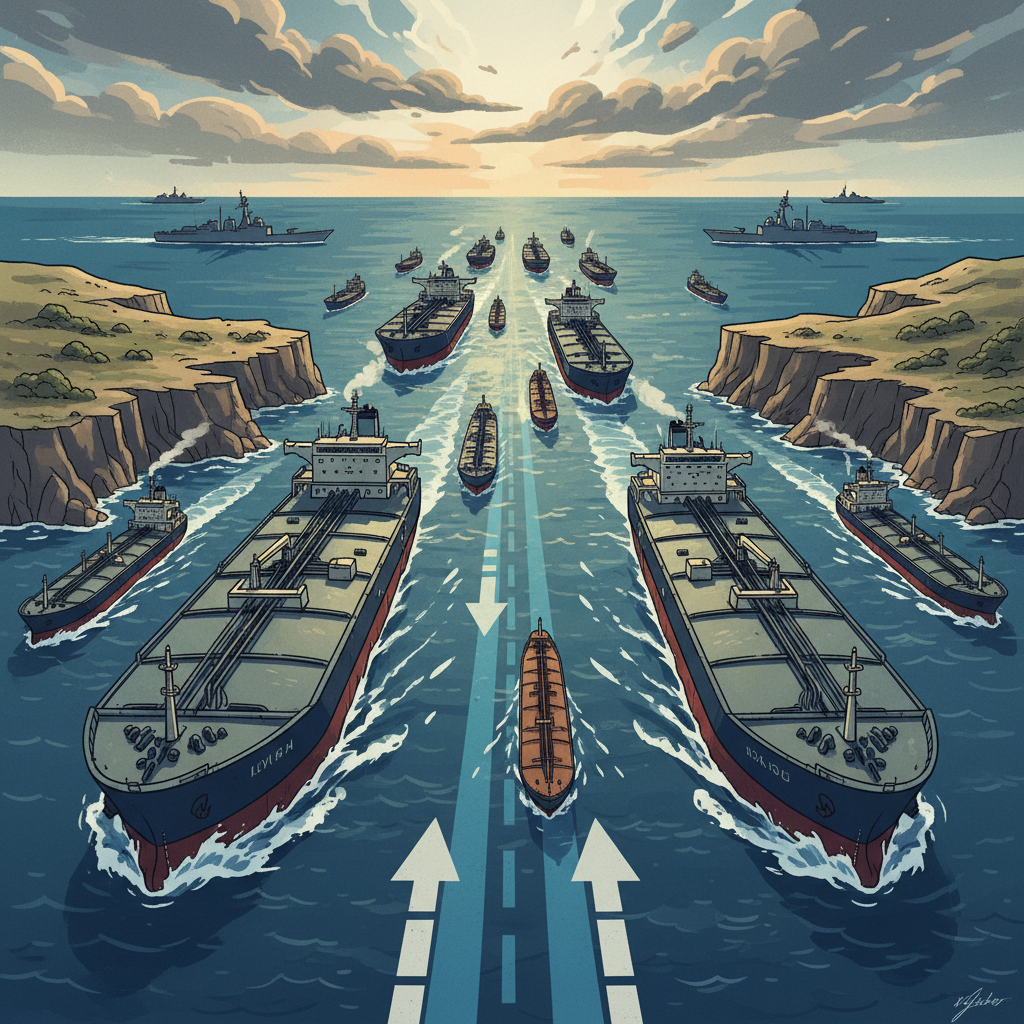
The strait of hormuz carries about 20% of global oil consumption each day, so any claim that one side is losing control has consequences far beyond the Gulf. If ships cannot pass safely, oil flows, LNG trade, and fuel prices can all move fast. The harder part is defining control: is it the power to threaten traffic, the power to stop it, or the power to keep it moving? That is the question this article answers.
Control means moving ships
The Strait of Hormuz matters because volume is concentrated there. It is the world’s most important oil transit chokepoint, and in 2025 an average of 20.7 million barrels per day of crude oil, condensate, and petroleum products moved through it. About one-fifth of global liquefied natural gas trade also flows through the strait. When that much energy passes through one waterway, control is measured by passage, not by rhetoric alone. Source Source
The mechanism is simple. Tankers and LNG carriers only deliver cargo if they can transit the chokepoint on schedule and with acceptable risk. If traffic slows, reroutes, or stops, buyers compete for fewer available barrels and cargoes. That is why a disruption in one narrow waterway can reach consumers far from the Gulf.
Safe passage in the strait is not ad hoc. The International Maritime Organization has a mandatory traffic separation scheme there, operated jointly by Iran and Oman, to keep navigation organized. A separation scheme works by channeling ships into defined lanes, reducing crossing conflicts in a narrow and strategically sensitive route. Source
Pressure and passage differ
Iran has been accused of exploiting the strait to extract tolls and threaten shipping, and the United States has called for international action to defend freedom of navigation. That shows one kind of influence: the ability to raise risk and impose costs on shipping. Source
A different kind of control is the ability to keep commercial traffic moving despite those threats. The US Navy’s Fifth Fleet, based in Bahrain, routinely escorts commercial vessels and has conducted operations to ensure safe passage through the strait. The US and its allies have also established an enhanced security area on the southern side of the strait, protected by land, naval, and air assets. That changes the balance because shipping does not depend only on who can menace the waterway. It also depends on who can organize escorts, patrol key lanes, and reduce the risk enough for commercial voyages to continue. Source
By that standard, “losing control” does not mean Iran has no power in the strait. It means coercion may not translate into lasting command over outcomes if outside naval protection keeps traffic flowing and international rules continue to treat transit passage as protected.
Where the simple story breaks
Threats can still move markets
The simple story is that escorts solve the problem. The market data shows the limit of that idea. OPEC crude oil production fell by 7.89 million barrels per day to 20.79 million barrels in March 2026 due to the near-closure of the Strait of Hormuz. A chokepoint does not need to be sealed permanently to hit supply. Even a near-closure can remove millions of barrels per day from expected output because producers, shipowners, and buyers react before a full stop becomes official. Source
Rules exist, but force matters
The IMO Council reaffirmed in July 2026 that the right of transit passage through international straits must not be threatened, impeded, or suspended. That is a legal and diplomatic baseline, not a guarantee of calm seas. Rules shape legitimacy and coalition building. Naval assets shape whether merchant ships can actually pass in practice. Source
The same gap appears at the United Nations. In May 2026, the US and Gulf Arab nations drafted a Security Council resolution requiring Iran to cease attacks and tolling in the strait. A month earlier, Russia and China vetoed a resolution that aimed to boost security and reopen the strait. Diplomatic backing can build pressure, but vetoes can block collective enforcement. Source Source
US consumers are not insulated
The United States is largely energy independent and imports less than 5% of its oil through the Strait of Hormuz, yet global oil price spikes still affect US consumers. The mechanism is global pricing. If a chokepoint that handles about 20% of global oil consumption is disrupted, benchmark prices can rise even when the barrel burned in the US did not sail through the Gulf. Source Source
Read the 2026 signals
If you want a practical way to judge whether Iran is losing control, track three signals in order: flow volume, shipping security, and diplomatic leverage. Flow volume tells you whether cargo is moving. Security operations tell you who is keeping lanes open. Diplomatic results tell you whether that shipping protection has broad backing or faces political limits.
| Period | Oil flow or output signal | What it tells you |
|---|---|---|
| 2025 baseline | 20.7 million barrels per day transited the strait | The normal scale of traffic any disruption must be measured against |
| March 2026 crisis | OPEC output fell by 7.89 million barrels per day to 20.79 million | Threats and near-closure were strong enough to cut supply materially |
| July 2026 diplomacy | IMO reaffirmed transit passage must not be threatened, impeded, or suspended | International legal support favored open navigation |
| 2026 security response | Fifth Fleet escorts and southern security area remained in place | Outside forces retained capacity to protect commercial movement |
| Consumer impact | US imports through the strait are under 5% | US exposure comes mainly through global prices, not direct dependence |
A second check is the human and shipping cost. The IMO reported that at least 70 attacks on international shipping had been verified in the Strait of Hormuz since February 2026, with 19 seafarers killed. Those numbers matter because “control” that relies on intimidation can still impose severe costs even if it fails to shut the lane completely. Source
For a practical reading, separate three outcomes. If attacks rise and flows fall, coercive control is gaining. If attacks persist but escorted traffic continues, disruption power remains but full control is weaker. If diplomatic pressure grows while escorted traffic stabilizes, Iran may still be dangerous in the strait without being able to dictate the final result.
Use the right decision test
Do not judge the strait by a single statement that it is closed or open. Check whether roughly 20.7 million barrels per day is being sustained, whether verified attacks are rising, and whether escorted commercial transit continues under the existing traffic scheme and security area.
If your concern is gasoline prices in the US, watch global supply shocks first. Less than 5% of US oil imports pass through the strait, but a chokepoint that carries about 20% of global oil consumption can still push up prices at home. If your concern is geopolitical control, watch who can keep merchant shipping moving for weeks at a time. That is the clearest test of real control in a waterway built around transit.
| Key Point | Detail |
|---|---|
| Global oil role | About 20% of global oil consumption passes through the Strait of Hormuz daily |
| 2025 transit level | Average flow was 20.7 million barrels per day |
| Global LNG role | About one-fifth of global LNG trade uses the strait |
| 2026 shipping danger | At least 70 verified attacks and 19 seafarer deaths since February 2026 |
| US reader action | Watch flow volumes, verified attacks, and escorted passage instead of any single closure claim |
Sources
- The Strait of Hormuz is the world’s most important oil transit chokepoint — U.S. Energy Information Administration (EIA) (checked 2026-09-07)
- Amid regional conflict, the Strait of Hormuz remains critical oil chokepoint — U.S. Energy Information Administration (EIA) (checked 2026-09-07)
- ‘Project Freedom’ Aims to Get Thousands of Commercial Ships Safely Through Strait of Hormuz — U.S. Department of War (Defense) (checked 2026-09-07)
- UN Security Council High-Level Open Debate – The safety and protection of waterways in the maritime domain — International Maritime Organization (IMO) (checked 2026-09-07)
- Countering Iran’s Exploitation of the Strait of Hormuz — U.S. Department of State (checked 2026-09-07)
- The United States Proposes a UN Security Council Resolution to Defend Freedom of Navigation and Secure the Strait of Hormuz — U.S. Department of State (checked 2026-09-07)
- Six months of uncertainty for seafarers in Strait of Hormuz — International Maritime Organization (IMO) (checked 2026-09-07)
- OPEC output plummets to 20-year low on Iran curbs and Hormuz closure — Reuters (checked 2026-09-07)
Leave a Reply