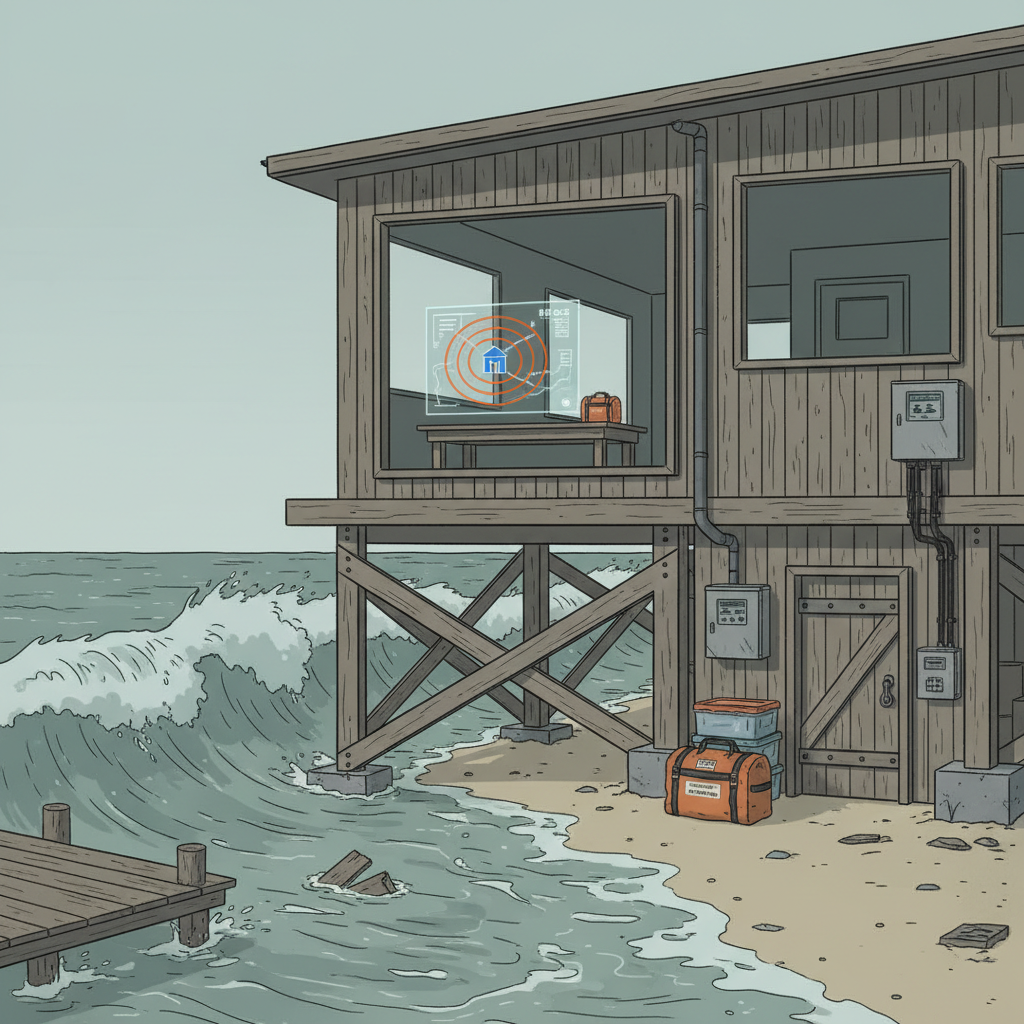
Just 1 inch of floodwater can cause $10,000 to $27,000 in home damage, and coastal flooding can turn a waterfront into a rushing wall of water when storm surge pushes inland. That mix of fast water, building rules, and evacuation timing makes small mistakes expensive, so the real question is which steps matter first for your home and when you should act.
Storm surge changes the risk
Storm surge is the most dangerous and destructive part of coastal flooding. The danger rises because coastal water does not stay at the shoreline when surge builds. It moves inland with force, which is why a property that looks merely close to the water can face deep, fast-moving floodwater during a coastal storm.
That is also why elevation standards focus on the Base Flood Elevation, or BFE. In coastal communities, FEMA recommends elevating utilities at least 12 inches above the BFE. The mechanism is simple: when electrical, heating, and other utility systems sit higher than expected flood levels, floodwater is less likely to reach the systems that keep a home functioning.
The same logic applies to the lower part of the building. Flood-resistant materials such as tile and flood-resistant insulation should be used below the BFE to minimize damage. Materials in that zone are the first part of the home to meet floodwater, so the more water-tolerant those materials are, the less damage the home may take where flooding is most likely to occur.
In the highest-risk coastal flood zones, many areas require that no living space or garages be built below the BFE. That rule exists because the lowest part of the structure is the part most likely to flood first and hardest to protect once water arrives.
Flood maps set the baseline
Once storm surge explains the danger, the next step is finding the line local rules are built around. FEMA flood maps, called FIRMs, specify areas of risk, including the 1% annual chance floodplain, also known as the 100-year floodplain or Special Flood Hazard Area.
The map matters because the National Flood Insurance Program requires all new development in Special Flood Hazard Areas to be elevated so that the lowest floor is at or above the 1% annual chance flood level. The flood map is not just a planning document. It sets the elevation target that drives how low floors, utilities, and building materials should be handled.
That baseline also carries into broader building practice. ASCE 24 (2014) is the referenced US standard for flood-resistant design and construction, including retrofits. If you are planning major work instead of small upgrades, that is the design framework tied to flood-resistant construction rules.
Rules shift by zone and funding
The simple rule is to build at or above the mapped flood level. The complication is that the exact requirement changes with the property condition.
In a high-risk flood area, flood insurance is mandatory for homes with mortgages from federally backed lenders. That threshold is about both location and financing. A home outside that lending condition does not trigger the same requirement through that rule, even though flooding can still cause major damage.
Federal funding can also raise the bar. HUD’s Federal Flood Risk Management Standard applies to all new federally funded construction in floodplains and requires higher elevation and floodproofing standards. That means a project can face stricter flood rules not only because of flood zone, but also because of where the money comes from.
Community rules can move in the same direction. FEMA’s Community Rating System gives communities an incentive to exceed minimum floodplain management standards in exchange for lower insurance premiums. The trade-off is straightforward: stricter local floodplain rules can mean more upfront limits on construction, while the benefit can be lower insurance costs for policyholders in that community.
Home upgrades do not all work the same
Structural and nature-based protections both appear in coastal risk reduction plans. The US Army Corps of Engineers recommends structural approaches such as levees and seawalls, along with nature-based approaches such as wetland restoration and beach nourishment.
Those are not interchangeable at the household level. A seawall or levee is a built barrier. Wetlands and beaches reduce risk through landscape changes that can absorb or weaken coastal water energy. If you are thinking about your own property, the key point is that community-scale protection can involve more than one method, and your home-level decisions still need to follow elevation and material rules.
Action steps before water rises
If your home is in a mapped 1% annual chance floodplain or coastal Special Flood Hazard Area, start with the BFE. Check whether utilities are at least 12 inches above that elevation target, and check whether any finishes below the BFE use flood-resistant materials such as tile and flood-resistant insulation.
If you are planning new work or a major retrofit, use a decision path that follows the flood map first, then the rule that attaches to that map.
| Condition | What to do |
|---|---|
| Home is in a FEMA Special Flood Hazard Area | Use the mapped 1% annual chance flood level as the baseline for lowest-floor elevation. |
| Utilities are below the BFE | Plan to elevate utilities to at least 12 inches above the BFE in coastal communities. |
| Walls or finishes are below the BFE | Use flood-resistant materials such as tile and flood-resistant insulation below the BFE. |
| Mortgage is from a federally backed lender in a high-risk flood area | Expect flood insurance to be mandatory. |
| Project is new federally funded construction in a floodplain | Check whether higher HUD elevation and floodproofing standards apply. |
Preparation also has a time threshold. The CDC recommends an emergency supply kit with enough safe food and water for each person for at least 3 days. That number matters because evacuation, road closures, and utility disruptions can separate you from stores and clean water long before floodwater leaves the area.
If officials order an evacuation, leave immediately. Lock your home, and disconnect utilities if time allows. If there is standing water or fallen power lines, the CDC recommends turning off electrical power and gas before evacuating.
Do not drive or walk through floodwaters. Six inches of moving water can knock over an adult, and 2 feet can carry away a car. Floodwater is dangerous not only because of depth and movement, but also because it can contain sewage, chemicals, and debris that raise the risk of diarrheal disease and chemical exposure.
Standards comparison by action
| Action area | Usable standard or rule |
|---|---|
| Lowest floor | In Special Flood Hazard Areas, new development must place the lowest floor at or above the 1% annual chance flood level. |
| Utilities | In coastal communities, elevate utilities at least 12 inches above the BFE. |
| Materials below flood level | Use flood-resistant materials such as tile and flood-resistant insulation below the BFE. |
| Major design framework | ASCE 24 (2014) is the referenced standard for flood-resistant design and construction, including retrofits. |
| Federally funded new work | HUD’s FFRMS requires higher elevation and floodproofing standards in floodplains. |
For a practical next step, pull your FEMA flood map, find the BFE for your property, and compare that number with your lowest floor, utility locations, and any planned renovation. If the numbers do not line up, that is the place to act before the next coastal flooding event puts water where your home is weakest.
Quick reference table
| Key Point | Detail |
|---|---|
| Damage threshold | 1 inch of floodwater can cause $10,000 to $27,000 in damage to a home, depending on size. |
| Map to check | FEMA FIRMs show the 1% annual chance floodplain, also called the 100-year floodplain or SFHA. |
| Elevation target | In coastal communities, utilities should be at least 12 inches above the BFE. |
| Evacuation rule | If ordered to evacuate, leave immediately; lock your home and disconnect utilities if time allows. |
| Floodwater danger | 6 inches of moving water can knock over an adult, and 2 feet can carry away a car. |
Sources
- Protect Your Property from Storm Surge — Federal Emergency Management Agency (FEMA) (checked 2026-09-05)
- Preparing for Floods | Floods | CDC — Centers for Disease Control and Prevention (CDC) (checked 2026-09-05)
- Safety Guidelines: Floodwater | Floods | CDC — Centers for Disease Control and Prevention (CDC) (checked 2026-09-05)
- Coastal Flood Risk | FEMA.gov — Federal Emergency Management Agency (FEMA) (checked 2026-09-05)
- Flood Insurance — Federal Emergency Management Agency (FEMA) (checked 2026-09-05)
- Coastal Risk Reduction and Resilience — US Army Corps of Engineers (checked 2026-09-05)
- ASCE 24 (2014) Flood Resistant Design and Construction — National Institute of Standards and Technology (NIST) (checked 2026-09-05)
- Flood Insurance Rules and Legislation | FEMA.gov — Federal Emergency Management Agency (FEMA) (checked 2026-09-05)
- ‘A Win for Flood Resilience’: HUD Rolls Out New Flood Standard — US Department of Housing and Urban Development (HUD) (checked 2026-09-05)
Leave a Reply